Skip to product information
1 of 2

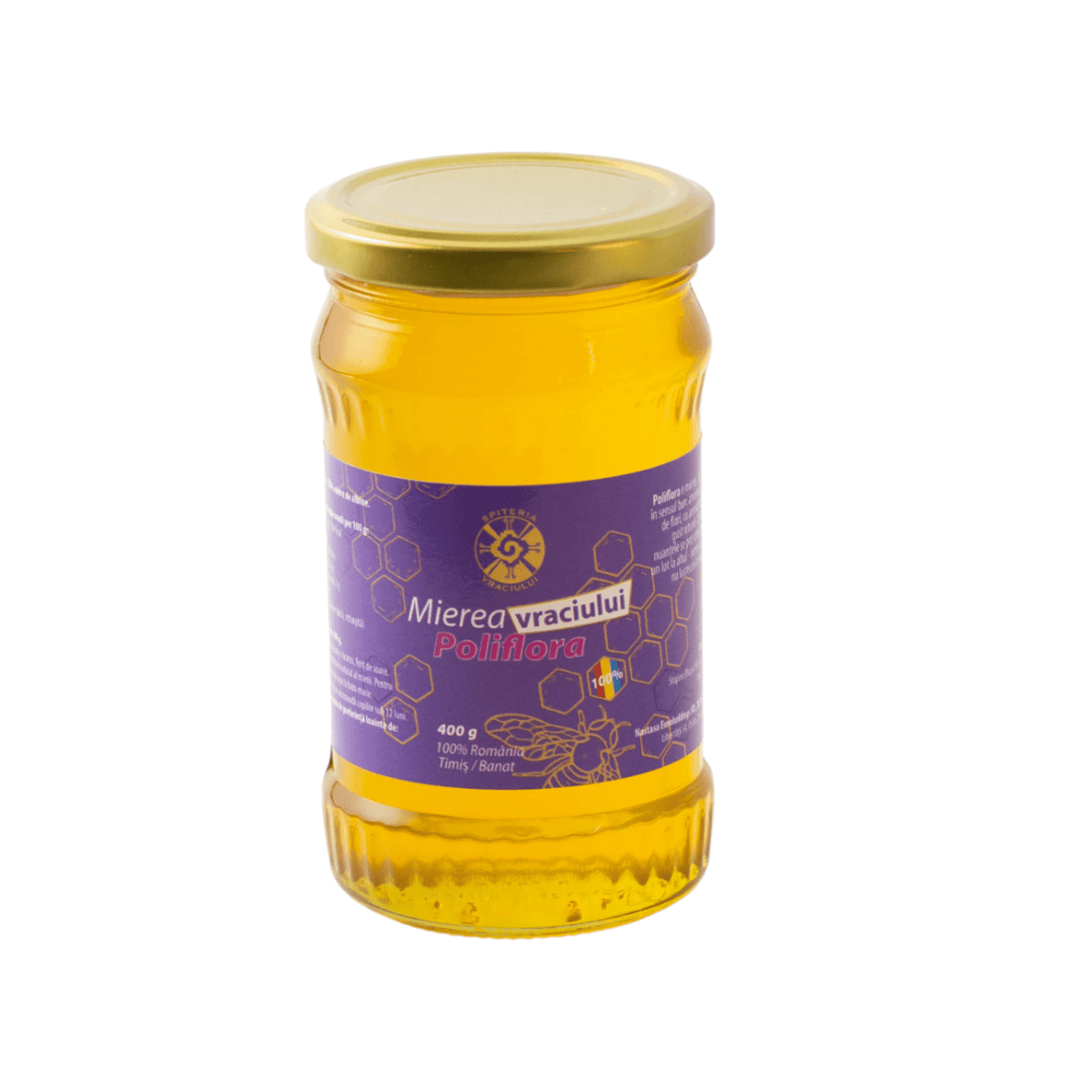
Natural Wildflower Honey – Mierea Vraciului | Raw Romanian Honey

Regular price 22 lei RON
Sale price 22 lei RON Regular price
Tax included. Shipping calculated at checkout.
Out of stock

Spițeria Vraciului · Natural Apicultural Product
Polyfloral Honey The sweetness of nature in all its glory · Banat
🍯 100% Natural · Unpasteurized 🌸 Over 100 Flower Species · Banat 🇷🇴 From Apiary to Jar
Authentic honey from the fields of Banat

Polyfloral honey is authentic field honey — a natural blend created by bees from hundreds of flower species in Banat. Each jar is unique, reflecting the floral diversity of that particular summer and place. Variable by definition, non-standardized, with the aroma and taste determined by nature.

Our polyfloral honey is minimally filtered and unpasteurized — it retains the pollen, active enzymes, and natural properties that fundamentally distinguish it from industrially processed honey.

Why poliflorous — from many flowers

Unlike monoflorous honey (from a single plant), poliflorous honey brings together the nutritional diversity of dozens of flower species — fields, orchards, forests, and medicinal plants — in a single jar.

Recognized properties

  • Honey is traditionally recognized for its natural energizing properties, thanks to fast-absorbing and long-lasting carbohydrates (glucose and fructose)
  • The natural antibacterial properties of honey are supported by the presence of inhibin (enzymatically produced hydrogen peroxide) and natural acidity (pH 3.5–4.5)
  • Unpasteurized honey contains active enzymes (diastase, invertase, glucose oxidase) and all 18 essential amino acids
  • Rich in flavonoids and phenolic acids with antioxidant properties recognized in traditional phytotherapy
  • Traditionally used as a remedy to soothe throat and upper respiratory tract irritation
  • Contains over 20 minerals in organic form: potassium, calcium, magnesium, iron, zinc, selenium, copper, and others
What natural honey contains

Authentic honey is not simply liquid sugar — it is a complex food created by bees through a unique enzymatic process.

🍬 Natural sugars

82.4g per 100g. Fructose (38%) with slow absorption + glucose (31%) for immediate energy. Complete fuel, without the "crashes" of refined sugar.

🧬 Active enzymes

Over 80 enzymes (diastase, invertase, glucose oxidase) — present only in unpasteurized honey. They are destroyed at temperatures above 40°C.

💎 Vitamins and minerals

Complete B complex (B1–B9), vitamin C and K. Over 20 minerals in organic form with maximum absorption: iron, calcium, magnesium, zinc, selenium.

🛡️ Antioxidants and antibacterials

Flavonoids (quercetin, apigenin), phenolic acids, and natural inhibin. Acidic environment (pH 3.5–4.5) that inhibits bacterial growth.

📊 Nutritional values per 100g Energy: 304 kcal · Carbohydrates: 82.4g (natural sugars) · Protein: 0.3g · Fat: 0g · Fiber: 0g · Salt: 0g. One tablespoon (approx. 20g) = approx. 61 kcal.
Uses recognized in traditional phytotherapy

Honey is one of humanity's oldest natural foods and remedies. Its traditional uses are supported by a wealth of European ethnobotanical experience.

⚡
Natural Energy
Dual energy source: glucose for immediate action, fructose for long-lasting support. The brain's preferred fuel.
🤧
Respiratory Comfort
Traditionally used to soothe throat irritation and coughs. It coats the mucous membranes, with a local soothing and antibacterial effect.
🛡️
Natural Immunity
Natural antibacterial, antiviral, and antifungal properties. Supports the body's overall resistance during the cold season.
🍽️
Healthy Digestion
Natural prebiotic effect — supports a healthy intestinal flora. Traditionally used to soothe gastric discomfort.
😴
Better Sleep
A teaspoon with warm milk before bedtime — a traditional remedy for calmer sleep and deeper rest.
🌟
Natural Beauty
Used externally in facial and hair masks thanks to its moisturizing and antioxidant properties. Radiant, hydrated skin.
How to consume and use
🥄 Direct consumption · Doses
  • Adults: 1–3 tablespoons per day
  • Children (1–12 years): ½–1 teaspoon per day
  • Athletes: 2–4 tablespoons (before/after exercise)
  • Cold season: 1 teaspoon every 3–4 hours
🍵 In beverages
  • Add after the tea has cooled below 40°C
  • Warm milk — classic for sleep
  • Water with lemon in the morning — detox
  • Smoothies as a natural sweetener
🍞 In the kitchen
  • On bread, in yogurt or cereal
  • Natural glaze for meat
  • Honey and mustard salad dressing
  • Sugar substitute: 75g honey = 100g sugar
🧖 External use
  • Facial mask: 15–20 min, washed off with warm water
  • Hair mask with coconut oil, 30 min
  • Local treatment for minor wounds and light burns
  • Brown sugar body scrub
⚠️

Temperature

Do not add to hot liquids. Above 40°C, enzymes and vitamins are irreversibly destroyed.

🌡️

Storage

15–25°C, dry place, away from direct light. Always use a clean and dry teaspoon.

❄️ About crystallization — a sign of quality Polyfloral honey naturally crystallizes in 2–6 months. Crystallization is proof that the honey is 100% natural and unprocessed — fake or pasteurized honey does not crystallize. It does not affect the taste, properties, or nutritional value. To liquefy: place the jar (without a metal lid) in a warm water bath at a maximum of 40°C for 15–30 minutes. Do not use a microwave.
What the package contains
Weight Glass jar with airtight lid · 400g
Enough for 13–40 days (depending on consumption: 1–3 tablespoons/day)
Processing Minimal filtering (coarse sieve) · Unpasteurized · No additives
Free from Added sugar, colorants, preservatives, glucose syrups, additives

Harvested exclusively from the Timiș / Banat area — fertile fields with exceptional floral diversity. Produced by local beekeepers in small apiaries, with respect for the bees and nature. Short, transparent supply chain: directly from the apiary to the jar, without intermediaries and without industrial processing. Harvest period: summer (June–August). Free from pesticide or antibiotic residues.

Essential medical information

⚕ Attention — temperature and diabetes

Do not heat honey above 40°C — high temperatures destroy enzymes and active properties. People with diabetes should consult their doctor before consumption: honey has a lower glycemic index than refined sugar (55 vs 70), but it still affects blood sugar and requires monitoring.

Contraindications and precautions

  • Do not administer to children under 12 months — risk of infant botulism (spores in honey can be dangerous for babies)
  • Do not administer to people with an allergy to honey or bee products
  • People with diabetes should consult their doctor and monitor their blood sugar
  • People who are undergoing diabetes treatment (insulin or oral antidiabetics) should consult their doctor — honey can affect blood sugar
  • Pregnant women can consume honey normally; in case of doubt, consult your doctor
  • If signs of an allergy appear (itching, hives, swelling in the mouth or throat, difficulty breathing) — stop immediately and contact your doctor
  • Do not leave within reach of children under 1 year
  • Store at 15–25°C, in a dry place, away from direct sunlight

Frequently asked questions

Is it pure honey?
Yes, 100% natural honey from Romanian hives, with nothing added, unpasteurised and not heat-treated.
Why does honey crystallise?
Crystallisation is a natural process and a sign that the honey has not been heated. You can make it liquid again in a bain-marie, at no more than 40°C.
How should honey be stored?
At room temperature, in a dry place away from sunlight. It does not need to be kept in the fridge.


Sorry, it's out of stock.

But we can let you know when it's back in.